Living Federated Digital Twins: Self-Evolving Digital Twins for Autonomous Wireless Networks (to appear)
Abstract
Next-generation wireless networks are expected to operate in highly dynamic environments characterized by dense deployments, distributed intelligence, and continuously changing radio conditions. Digital twins (DTs) have emerged as a promising tool for network monitoring, optimization, and automation. However, most existing DT implementations remain static and rely on centralized data collection and model training. Such designs limit their ability to adapt to evolving network conditions while raising concerns regarding scalability, communication overhead, and data privacy.
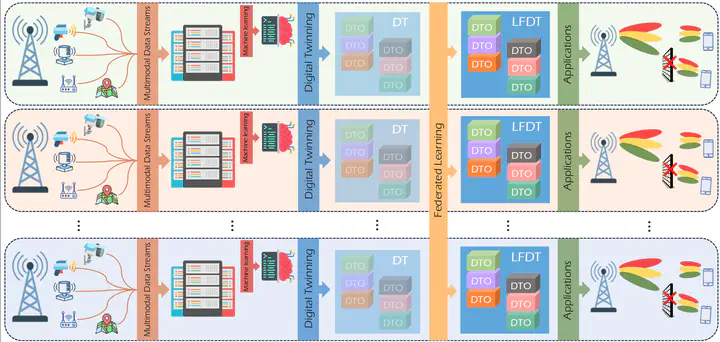
In this paper, we introduce Living Federated Digital Twins (LFDTs), an architecture that allows DTs to continuously evolve through distributed learning. The proposed framework is built around DT objects (DTOs), modular representations of network entities that collaboratively learn through federated learning (FL) without exchanging raw data. We demonstrate the feasibility of the concept through a beam and blockage prediction case study using multimodal wireless and visual data. Results show that continuous updates enable beam prediction accuracy to improve from 60.4% to 91.0% and blockage prediction accuracy from 59.9% to 97.5%, while achieving performance close to centralized learning. These findings show the potential of LFDTs as a foundation for adaptive and intelligent network management in future wireless systems.
